Battery Testing Equipment in 2026: Trends Shaping Safety & Performance Standards
Explore the future of battery testing equipment in 2026. Discover how AI, solid-state batteries, and stringent safety standards are redefining performance testing for EVs and ESS.
Environmental Test Chamber Climate Test Chamber Salt Spray Test Chamber UV Aging Test Chamber Thermal Shock Test Chamber Dust Test Chamber Rain Test Chamber Boiling Test Chamber Dry Dehumidification Cabinet Xenon Test Chamber Universal Tensile Test Equipment Single Column Series Double Column Series Fixtures Drying Oven 200℃ Oven 300℃ Oven 400℃ Oven 500℃ Oven Vacuum Oven 27L Vacuum Oven 64L Vacuum Oven 125L Vacuum Oven 216L Vacuum Oven 512L Vacuum Oven 729L Vacuum Oven 1000L Vacuum Oven Two-box Vacuum Oven Three-box Vacuum Oven Vibration Shaker Table System Simulated Transportation Vibration Table Vertical Vibration Table Vertical Horizontal Vibration Table XYZ Three Axis Vibration Table Rubber And Plastic Test Equipment VICAT Tester Melt Flow Index Tester Flammability Test Equipment Charpy & Izod Impact Tester Paper Packaging Test Equipment Edge And Ring Crush Tester Drop Tester Carton Compression Tester Bursting Strength Tester Battery Test Equipment Videos About Us Our Partners & Clients Certifications & Honors Factory & Gallery Why Choose HAOEN Company Profile News Company News Industry News Contact 🇺🇸 English 🇫🇷 Français 🇩🇪 Deutsch 🇪🇸 Español .ml-sw{font-family:inherit;font-size:14px;line-height:1.5}.ml-dropdown{position:relative;display:inline-block;z-index:999}.ml-dd-trigger{display:flex;align-items:center;gap:6px;cursor:pointer;padding:4px 10px;border-radius:var(--ml-radius);color:var(--ml-text);transition:background .2s}.ml-dd-trigger:hover{background:rgba(0,0,0,.05)}.ml-dd-flag{font-size:18px}.ml-dd-icon{vertical-align:middle}.ml-dd-arrow{border:4px solid transparent;border-top:5px solid currentColor;margin-top:2px;transition:transform .2s}.ml-dropdown.open .ml-dd-arrow{transform:rotate(180deg)}.ml-dd-panel{display:none;position:absolute;top:100%;left:0;min-width:100%;width:max-content;background:var(--ml-bg);border-radius:var(--ml-radius);box-shadow:0 4px 16px rgba(0,0,0,.12);padding:4px 0;margin-top:4px}.ml-dropdown.open .ml-dd-panel{display:block}.ml-dd-item{display:flex;align-items:center;gap:8px;padding:8px 14px;color:var(--ml-text);text-decoration:none;transition:background .15s;white-space:nowrap}.ml-dd-item:hover{background:rgba(0,0,0,.04)}.ml-dd-item.active{color:var(--ml-primary);font-weight:500}.ml-dd-chk{margin-left:auto;font-size:12px}.ml-pills{display:flex;flex-wrap:nowrap;gap:6px;white-space:nowrap}.ml-pill{display:inline-flex;align-items:center;gap:4px;padding:4px 12px;border-radius:var(--ml-radius);background:var(--ml-bg);color:var(--ml-text);text-decoration:none;border:1px solid rgba(0,0,0,.1);transition:all .2s;font-size:13px;white-space:nowrap}.ml-pill:hover{border-color:var(--ml-primary);color:var(--ml-primary)}.ml-pill.active{background:var(--ml-primary);color:#fff;border-color:var(--ml-primary)}.ml-pill-flag{font-size:16px}.ml-bar{display:flex;gap:0;border-bottom:2px solid rgba(0,0,0,.06);white-space:nowrap}.ml-bar-item{display:inline-flex;align-items:center;gap:4px;padding:6px 14px;color:var(--ml-text);text-decoration:none;border-bottom:2px solid transparent;margin-bottom:-2px;transition:all .2s;font-size:13px;white-space:nowrap}.ml-bar-item:hover{color:var(--ml-primary)}.ml-bar-item.active{color:var(--ml-primary);border-bottom-color:var(--ml-primary);font-weight:500}.ml-bar-flag{font-size:16px}.ml-float{position:fixed;right:20px;bottom:20px;z-index:9999}.ml-float-btn{width:48px;height:48px;border-radius:50%;background:var(--ml-primary);color:#fff;border:none;cursor:pointer;box-shadow:0 4px 12px rgba(0,0,0,.2);transition:transform .2s;display:flex;align-items:center;justify-content:center;padding:0;line-height:1}.ml-float-btn:hover{transform:scale(1.1)}.ml-float-btn svg{width:24px;height:24px;display:block}.ml-float-panel{display:none;position:absolute;bottom:56px;right:0;min-width:160px;background:var(--ml-bg);border-radius:var(--ml-radius);box-shadow:0 4px 16px rgba(0,0,0,.12);padding:4px 0}.ml-float.open .ml-float-panel{display:block}.ml-float-item{display:flex;align-items:center;gap:8px;padding:8px 14px;color:var(--ml-text);text-decoration:none;transition:background .15s}.ml-float-item:hover{background:rgba(0,0,0,.04)}.ml-float-item.active{color:var(--ml-primary);font-weight:500}.ml-float-flag{font-size:18px} function mlSwToggle(){var e=document.getElementById("mlSw");if(e)e.classList.toggle("open")}document.addEventListener("click",function(e){var s=document.getElementById("mlSw");if(s&&!s.contains(e.target))s.classList.remove("open")}); News & Updates Stay informed with the latest industry news and company updates
The Catalysts Driving Battery Testing Evolution by 2026
News Industry News Industry News Battery Testing Equipment in 2026: Trends Shaping Safety & Performance Standards 2026-10-16 Industry News 1 views Global electrification is pushing energy storage technologies into uncharted territory. Electric vehicle (EV) manufacturers are demanding faster charging rates, longer range, and absolute safety. At the same time, grid-scale energy storage systems (BESS) require decades of operational reliability under harsh environmental conditions.
The year 2026 stands as a watershed moment for the industry. Next-generation chemistries like solid-state and sodium-ion batteries are moving from pilot facilities to commercial production. Concurrently, strict regulations, such as the European Union's Battery Passport and updated UL standards, are taking full effect.
Five Key Trends Defining Battery Testing Equipment in 2026
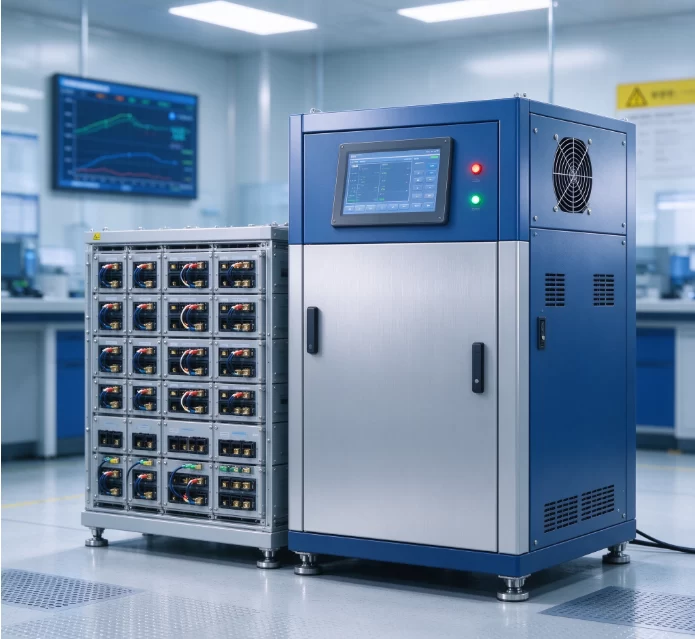
In this demanding environment, conventional quality assurance methods are no longer sufficient. Modern battery testing equipment is no longer just an end-of-line verification tool. It has transformed into a mission-critical data engine that governs the entire product lifecycle from laboratory formulation to full-scale manufacturing.
Engineering teams face mounting pressure to validate cells faster while eliminating safety liabilities. Specialized test equipment manufacturers like HAOEN design advanced systems that bridge this gap, helping developers verify performance while remaining fully compliant with upcoming global regulations.
Strategic Framework: Selecting Battery Testing Equipment
If you are planning laboratory expansions or upgrading your high-volume production facilities for 2026 compliance, connect with our engineering team today to review your project specifications and request a tailored quotation.
Position Your Operations for the Next Standard of Battery Performance
To navigate these commercial and technical hurdles, manufacturers are adopting new test architectures. Below are the five dominant trends defining the next generation of test hardware and software platforms.
Frequently Asked Questions
Traditional lifecycle validation requires cycling a cell for thousands of hours to measure capacity fade. This prolonged timeline delays vehicle launches and increases R&D overhead. By 2026, machine learning models integrated directly into the test software will eliminate much of this delay.
Key considerations for laboratory teams
Modern battery testing equipment now analyzes early-life cycling data—specifically subtle shifts in differential capacity (dQ/dV) curves during the first 100 cycles. Predictive algorithms extrapolate this data to forecast remaining useful life, State of Health (SOH), and early internal short circuits with high accuracy. This capability cuts validation timelines by up to 50%.
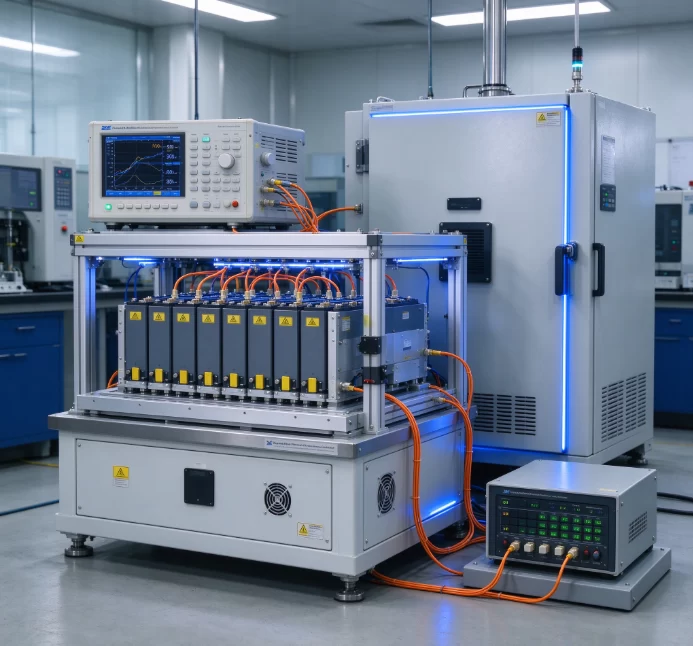
Furthermore, hardware-in-the-loop (HIL) systems run digital twins of the target battery pack alongside physical hardware. Engineers simulate dynamic drive cycles, sudden load drops, and regeneration events without destroying prototype hardware prematurely.
As cell chemistries become more complex, standard measurement tolerances are no longer acceptable. High-precision cell testing requires measurement accuracy down to the micro-volt and micro-amp level, combined with rapid sampling frequencies.
Accurate Coulombic Efficiency (CE) measurement serves as a direct indicator of parasitic side reactions within the cell. Detecting these micro-reactions requires measurement precision better than 0.01% of full scale. Newer cycling platforms feature independent channel control, allowing engineers to test diverse cell formats concurrently without channel cross-talk or thermal drift.
How HAOEN builds this equipment
The chamber described above is designed and manufactured in HAOEN's own plants in Dongguan, rather than assembled from purchased sub-assemblies. That distinction matters when a lab needs repeatable performance across a fleet of machines.
- Chamber geometry, airflow and insulation are engineered in-house and issued as controlled drawings
- Steel is cut, bent and welded on our own line, with stress relief and surface treatment between stages
- Refrigeration, electrical cabinets and sensor harnesses are installed and wired by our own technicians
- Each unit runs a full commissioning cycle with logged test data before the QC file is signed
- Export crating, anti-rust treatment and the complete document set are prepared in-house
Because engineering, production and calibration sit under the same roof, specification changes during a project are absorbed by the factory rather than passed between suppliers. Standard units follow the same route, which is why a catalogue model and a custom-built chamber carry the same documentation discipline.