Flammability Testing Machine Architecture: Lab Compliance & Fire Reaction Guide
Explore technical specifications, international standards, and calibration requirements for selecting an industrial-grade flammability testing machine.
Environmental Test Chamber Climate Test Chamber Salt Spray Test Chamber UV Aging Test Chamber Thermal Shock Test Chamber Dust Test Chamber Rain Test Chamber Boiling Test Chamber Dry Dehumidification Cabinet Xenon Test Chamber Universal Tensile Test Equipment Single Column Series Double Column Series Fixtures Drying Oven 200℃ Oven 300℃ Oven 400℃ Oven 500℃ Oven Vacuum Oven 27L Vacuum Oven 64L Vacuum Oven 125L Vacuum Oven 216L Vacuum Oven 512L Vacuum Oven 729L Vacuum Oven 1000L Vacuum Oven Two-box Vacuum Oven Three-box Vacuum Oven Vibration Shaker Table System Simulated Transportation Vibration Table Vertical Vibration Table Vertical Horizontal Vibration Table XYZ Three Axis Vibration Table Rubber And Plastic Test Equipment VICAT Tester Melt Flow Index Tester Flammability Test Equipment Charpy & Izod Impact Tester Paper Packaging Test Equipment Edge And Ring Crush Tester Drop Tester Carton Compression Tester Bursting Strength Tester Battery Test Equipment Videos About Us Our Partners & Clients Certifications & Honors Factory & Gallery Why Choose HAOEN Company Profile News Company News Industry News Contact 🇺🇸 English 🇫🇷 Français 🇩🇪 Deutsch 🇪🇸 Español .ml-sw{font-family:inherit;font-size:14px;line-height:1.5}.ml-dropdown{position:relative;display:inline-block;z-index:999}.ml-dd-trigger{display:flex;align-items:center;gap:6px;cursor:pointer;padding:4px 10px;border-radius:var(--ml-radius);color:var(--ml-text);transition:background .2s}.ml-dd-trigger:hover{background:rgba(0,0,0,.05)}.ml-dd-flag{font-size:18px}.ml-dd-icon{vertical-align:middle}.ml-dd-arrow{border:4px solid transparent;border-top:5px solid currentColor;margin-top:2px;transition:transform .2s}.ml-dropdown.open .ml-dd-arrow{transform:rotate(180deg)}.ml-dd-panel{display:none;position:absolute;top:100%;left:0;min-width:100%;width:max-content;background:var(--ml-bg);border-radius:var(--ml-radius);box-shadow:0 4px 16px rgba(0,0,0,.12);padding:4px 0;margin-top:4px}.ml-dropdown.open .ml-dd-panel{display:block}.ml-dd-item{display:flex;align-items:center;gap:8px;padding:8px 14px;color:var(--ml-text);text-decoration:none;transition:background .15s;white-space:nowrap}.ml-dd-item:hover{background:rgba(0,0,0,.04)}.ml-dd-item.active{color:var(--ml-primary);font-weight:500}.ml-dd-chk{margin-left:auto;font-size:12px}.ml-pills{display:flex;flex-wrap:nowrap;gap:6px;white-space:nowrap}.ml-pill{display:inline-flex;align-items:center;gap:4px;padding:4px 12px;border-radius:var(--ml-radius);background:var(--ml-bg);color:var(--ml-text);text-decoration:none;border:1px solid rgba(0,0,0,.1);transition:all .2s;font-size:13px;white-space:nowrap}.ml-pill:hover{border-color:var(--ml-primary);color:var(--ml-primary)}.ml-pill.active{background:var(--ml-primary);color:#fff;border-color:var(--ml-primary)}.ml-pill-flag{font-size:16px}.ml-bar{display:flex;gap:0;border-bottom:2px solid rgba(0,0,0,.06);white-space:nowrap}.ml-bar-item{display:inline-flex;align-items:center;gap:4px;padding:6px 14px;color:var(--ml-text);text-decoration:none;border-bottom:2px solid transparent;margin-bottom:-2px;transition:all .2s;font-size:13px;white-space:nowrap}.ml-bar-item:hover{color:var(--ml-primary)}.ml-bar-item.active{color:var(--ml-primary);border-bottom-color:var(--ml-primary);font-weight:500}.ml-bar-flag{font-size:16px}.ml-float{position:fixed;right:20px;bottom:20px;z-index:9999}.ml-float-btn{width:48px;height:48px;border-radius:50%;background:var(--ml-primary);color:#fff;border:none;cursor:pointer;box-shadow:0 4px 12px rgba(0,0,0,.2);transition:transform .2s;display:flex;align-items:center;justify-content:center;padding:0;line-height:1}.ml-float-btn:hover{transform:scale(1.1)}.ml-float-btn svg{width:24px;height:24px;display:block}.ml-float-panel{display:none;position:absolute;bottom:56px;right:0;min-width:160px;background:var(--ml-bg);border-radius:var(--ml-radius);box-shadow:0 4px 16px rgba(0,0,0,.12);padding:4px 0}.ml-float.open .ml-float-panel{display:block}.ml-float-item{display:flex;align-items:center;gap:8px;padding:8px 14px;color:var(--ml-text);text-decoration:none;transition:background .15s}.ml-float-item:hover{background:rgba(0,0,0,.04)}.ml-float-item.active{color:var(--ml-primary);font-weight:500}.ml-float-flag{font-size:18px} function mlSwToggle(){var e=document.getElementById("mlSw");if(e)e.classList.toggle("open")}document.addEventListener("click",function(e){var s=document.getElementById("mlSw");if(s&&!s.contains(e.target))s.classList.remove("open")}); News & Updates Stay informed with the latest industry news and company updates
Regulatory Frameworks and Testing Methodologies Governing Reaction to Fire
News Industry News Industry News Flammability Testing Machine Architecture: Lab Compliance & Fire Reaction Guide 2026-09-03 Industry News 1 views Quantifying how materials behave under direct flame contact, radiant heat flux, and elevated thermal conditions is a non-negotiable requirement across global manufacturing. Polymers, structural composites, commercial textiles, and electronic encapsulants require documented reaction-to-fire characteristics before entering regulated supply chains. Deploying an industrial-grade flammability testing machine provides engineering teams and quality assurance laboratories with empirical data on ignitability, self-extinguishing capabilities, flame propagation rates, and secondary combustion phenomena such as flaming drips or post-ignition char development.
Thermal degradation begins at the chemical bond level, progressing through endothermic decomposition to produce volatile gaseous hydrocarbons. These combustible gases mix with ambient oxygen at the boundary layer, producing a self-sustaining exothermic chain reaction when an ignition source is introduced. Accurately characterizing this progression demands high-precision apparatus designed to isolate variables such as airflow velocity, thermal radiation intensity, exhaust evacuation rates, and gas composition. Navigating these requirements demands a precise technical understanding of instrument design, standardized test protocols, and operational workflows.
Core Engineering Principles Behind a Modern Flammability Testing Machine
Fire test standards do not assess a material under arbitrary conditions; instead, they define reproducible exposures ranging from low-energy Bunsen-style burners to elevated radiant thermal envelopes. Selecting laboratory instrumentation requires strict compatibility with specific standardization regimes established by ISO, ASTM, IEC, and regional safety organizations.
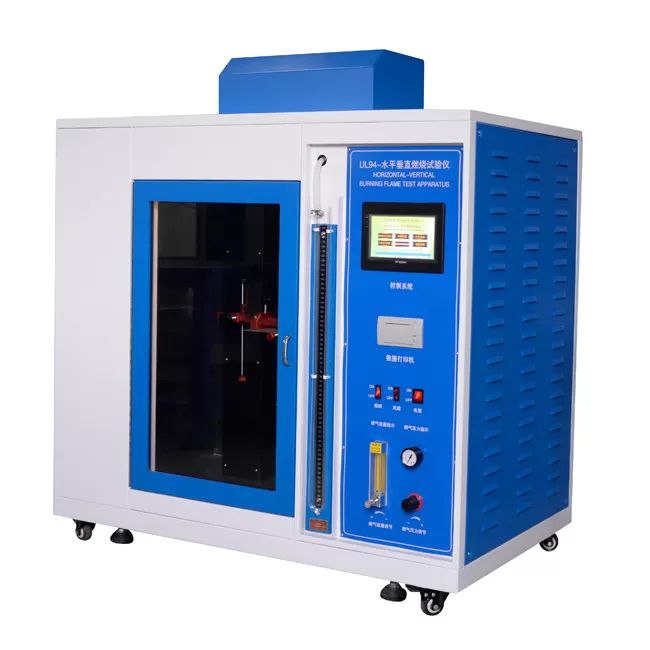
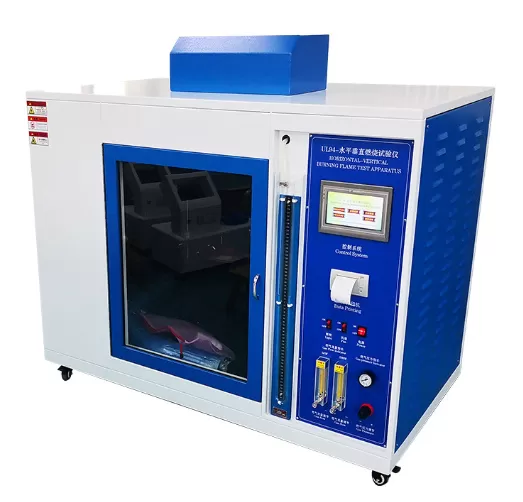
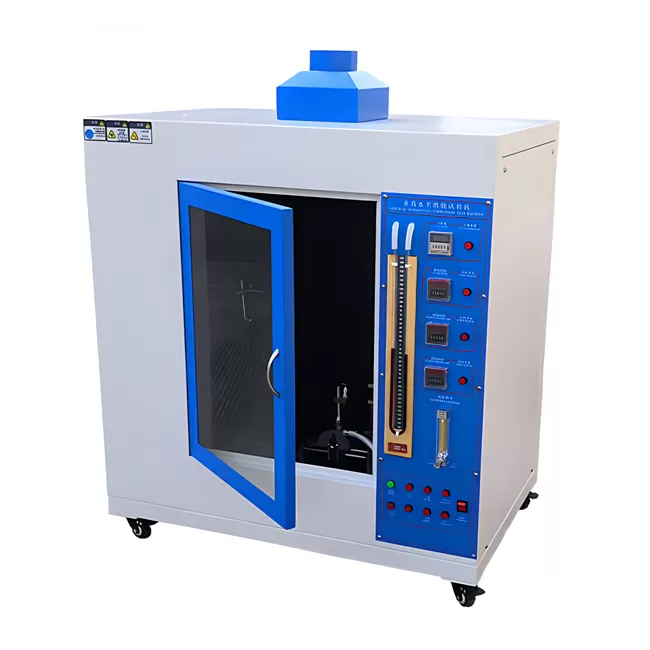
Vertical and Horizontal Bunsen Burner Tests: Governed by UL 94, ASTM D635, ASTM D3801, and IEC 60695-11-10. These methods determine burning rate, afterflame time, afterglow time, and whether molten polymers discharge burning particles capable of igniting surgical cotton situated beneath the specimen holder. Classifications range from HB (slow horizontal burn) through V-2, V-1, and V-0 (self-extinguishing vertical orientations), up to 5VA and 5VB ratings for industrial enclosures.
Material Pyrolysis Dynamics Across Industry Sectors
Oxygen Index Determination: Standardized under ISO 4589-2 and ASTM D2863. This procedure establishes the Limiting Oxygen Index (LOI), which represents the minimum volumetric concentration of oxygen in a blended oxygen-nitrogen stream that supports flaming combustion of a vertically oriented test specimen.
Technical Procurement Parameters for Quality Assurance and Testing Laboratories
Heat Release and Mass Loss Rate: Benchmarked through oxygen consumption calorimetry via ASTM E1354 and ISO 5660-1 (Cone Calorimeter). These standards quantify Peak Heat Release Rate (pHRR), Total Heat Release (THR), effective heat of combustion, and dynamic mass loss rate under uniform, user-specified external radiant heat fluxes reaching up to 100 kW per square meter.
Installation, Commissioning, and Environmental Controls
Every operational flammability testing machine relies on an integrated assembly of fluid controls, thermal barriers, structural mechanics, and digital telemetry to guarantee measurement repeatability across hundreds of test cycles.
Mitigating Drift and Managing Operational Integrity Over Extended Lifecycles
The interior test enclosure must be fabricated from high-grade, corrosion-resistant austenitic stainless steel, typically AISI 304 or 316, or lined with non-combustible, asbestos-free insulation boards capable of withstanding repetitive thermal cycling. Natural draft or mechanically regulated ventilation systems ensure that ambient air delivers adequate stoichiometric oxygen to the combustion envelope without introducing micro-drafts that perturb the laminar profile of the application burner. Tempered, heat-resistant observation windows constructed from borosilicate glass allow operators to monitor flame spread and dripping events safely without disturbing chamber pressure or internal draft equilibria.
Key considerations for laboratory teams
Precision flame application demands controlled exposure intervals down to the millisecond. Automated ignition systems drive certified Tirrill or Bunsen burners using motorized linear guide rails or pneumatic cylinders, ensuring zero manual variance during burner approach, dwell time, and withdrawal phases. The gas delivery train integrates digital mass flow controllers (MFCs) alongside needle valves to govern incoming fuel purity and flow velocity. Whether using methane, propane, or technical-grade butane, fuel flow rates must adhere strictly to standard-defined thermal output envelopes—typically verified by measuring the time required for a calibrated electrolytic copper block to heat through a defined temperature window.
Advanced flammability testing rigs integrate thermopiles, high-resolution load cells, and water-cooled Schmidt-Boelter or Gardon-type heat flux gauges. When testing specimens in horizontal, vertical, or angled orientations, specialized pneumatic or screw-clamped jigs must securely restrain the substrate to avoid thermal warping, edge-curling, or unrepresentative premature structural collapse. Signal conditioning units digitize microvolt outputs from thermocouples positioned within the flame zone or exhaust plume, channeling high-frequency data streams into acquisition software for real-time visualization and reporting.
Fire risks manifest differently depending on polymer chemistry, cellular structure, physical geometry, and end-use environments. Evaluating testing machinery requires an understanding of how distinct classes of materials decompose under flame exposure.
Structural Thermoplastics and Engineering Resins: Polyamides (PA), polycarbonates (PC), and polybutylene terephthalate (PBT) used in automotive connectors and switchgear undergo thermal chain-scission. The presence of halogenated or phosphorus-based flame retardants stimulates vapor-phase radical quenching or promotes condensed-phase char forming. Instrumentation must capture afterflame intervals precisely to classify self-extinguishment.
How HAOEN builds this equipment
The chamber described above is designed and manufactured in HAOEN's own plants in Dongguan, rather than assembled from purchased sub-assemblies. That distinction matters when a lab needs repeatable performance across a fleet of machines.
- Chamber geometry, airflow and insulation are engineered in-house and issued as controlled drawings
- Steel is cut, bent and welded on our own line, with stress relief and surface treatment between stages
- Refrigeration, electrical cabinets and sensor harnesses are installed and wired by our own technicians
- Each unit runs a full commissioning cycle with logged test data before the QC file is signed
- Export crating, anti-rust treatment and the complete document set are prepared in-house
Because engineering, production and calibration sit under the same roof, specification changes during a project are absorbed by the factory rather than passed between suppliers. Standard units follow the same route, which is why a catalogue model and a custom-built chamber carry the same documentation discipline.